The Big Idea
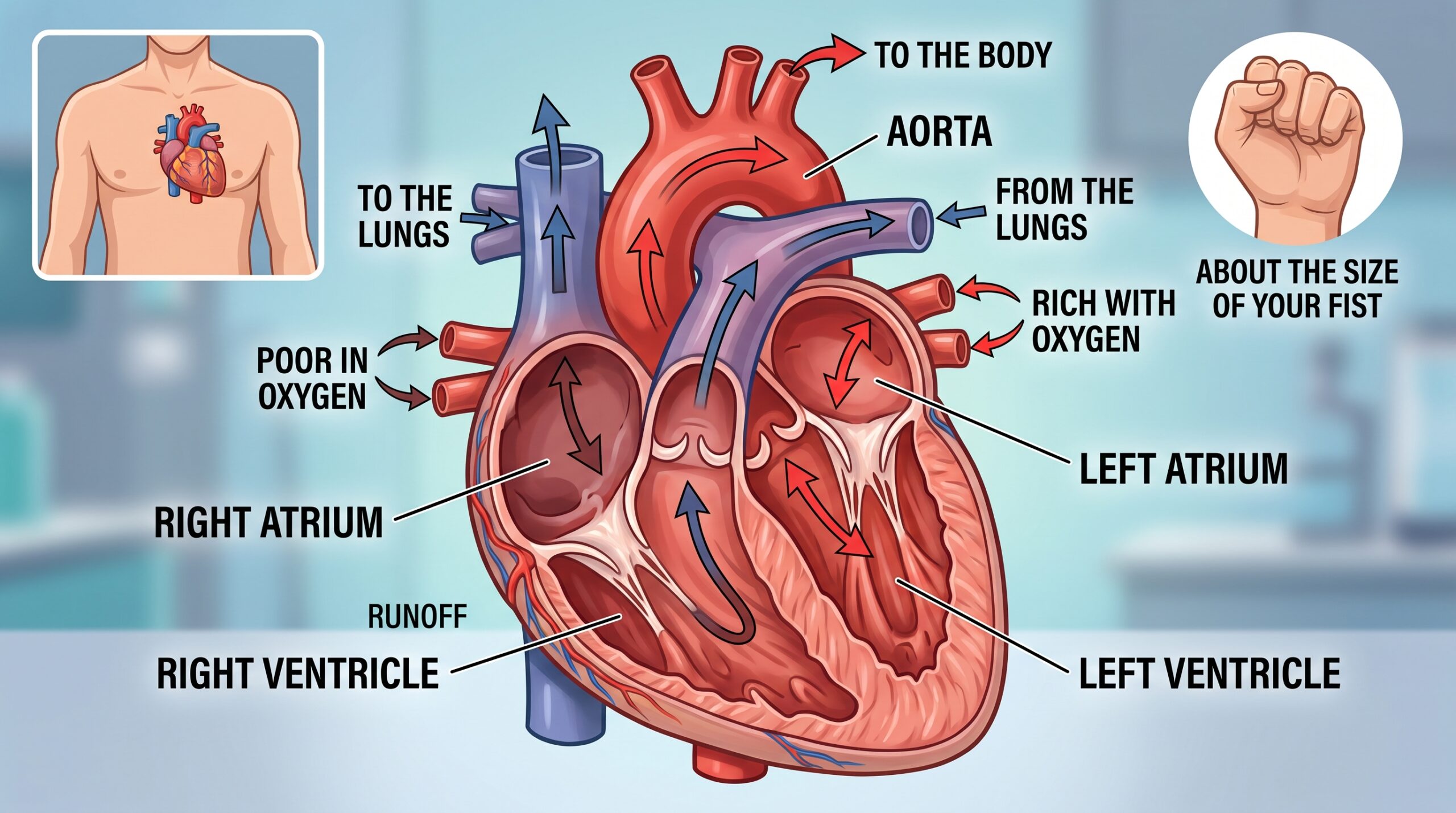
Your heart is one of the hardest working muscles in the natural world. It is roughly the size of your closed fist and sits slightly to the left in the center of your chest. From before you are born until the end of your life, your heart beats continuously without a single minute of rest. It beats around 100,000 times every day to keep blood flowing through your entire body.
How It Works
The heart operates like a powerful double pump with four distinct hollow chambers. The top two chambers are called the left and right atria, while the bottom two chambers are called the left and right ventricles. The right side of the heart receives blood that has already delivered its oxygen to your organs. This oxygen-poor blood is dark red and carries waste carbon dioxide. The right ventricle pumps this blood into your lungs, where you exhale the carbon dioxide and breathe in fresh oxygen.
Once the blood is rich with fresh oxygen, it flows into the left side of the heart. The left ventricle, which has thick and strong muscular walls, contracts with great force. It sends the bright red, oxygen-rich blood out through a large main artery called the aorta. From there, thousands of blood vessels carry oxygen and nutrients to your brain, toes, and every cell in between.
Why It Matters
Cells need continuous oxygen and glucose to produce energy and survive. Biomedical engineers design artificial heart valves and pacemaker devices to help people when heart muscles weaken. Taking care of your heart through regular exercise and a healthy diet keeps this vital mechanical pump running smoothly.
Key Vocabulary
- Ventricle: A muscular bottom chamber of the heart that pumps blood outward.
- Atrium: An upper chamber of the heart that receives incoming blood.
- Aorta: The main and largest artery that carries blood from the heart to the body.