Welcome! As an ESL curriculum designer and specialist in English for Specific Purposes (ESP), I have crafted a comprehensive 3-Level English for Nursing Course.
This syllabus is designed to build communicative competence, medical accuracy, and patient-centered communication across 72 total training hours (24 hours per level, delivered over 12 two-hour sessions).
Course Structure Overview
| Level | CEFR Level | Total Hours | Structure | Core Target |
|---|---|---|---|---|
| Level 1 | A1 – A2 | 24 Hours | 12 Sessions × 2 Hrs | Basic hospital routines, basic anatomy, taking vital signs |
| Level 2 | B1 | 24 Hours | 12 Sessions × 2 Hrs | Patient admission, medical history, treatments, handover |
| Level 3 | B2 | 24 Hours | 12 Sessions × 2 Hrs | Complex care, patient empathy, discharge, emergencies |
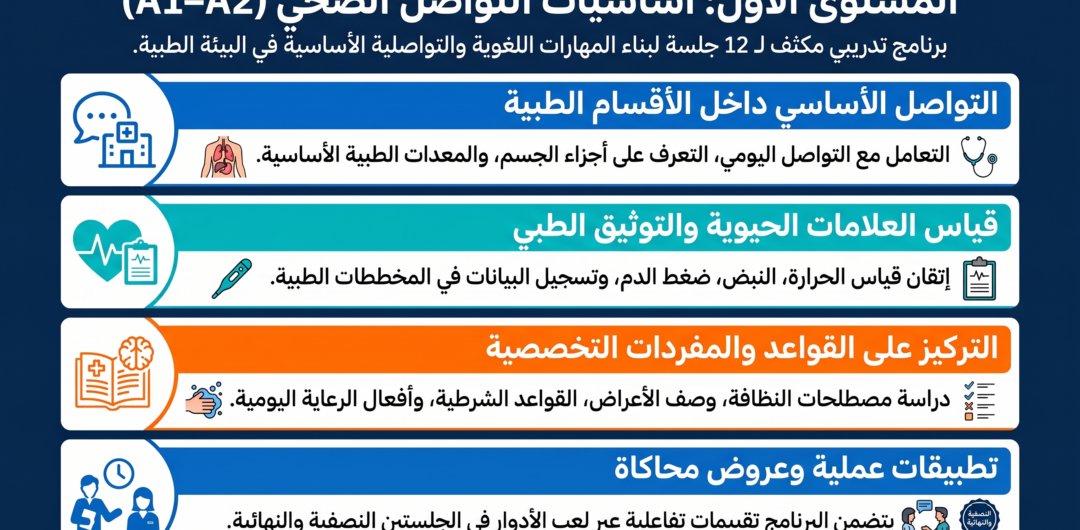
Level 1: Foundation in Healthcare Communication (A1–A2)
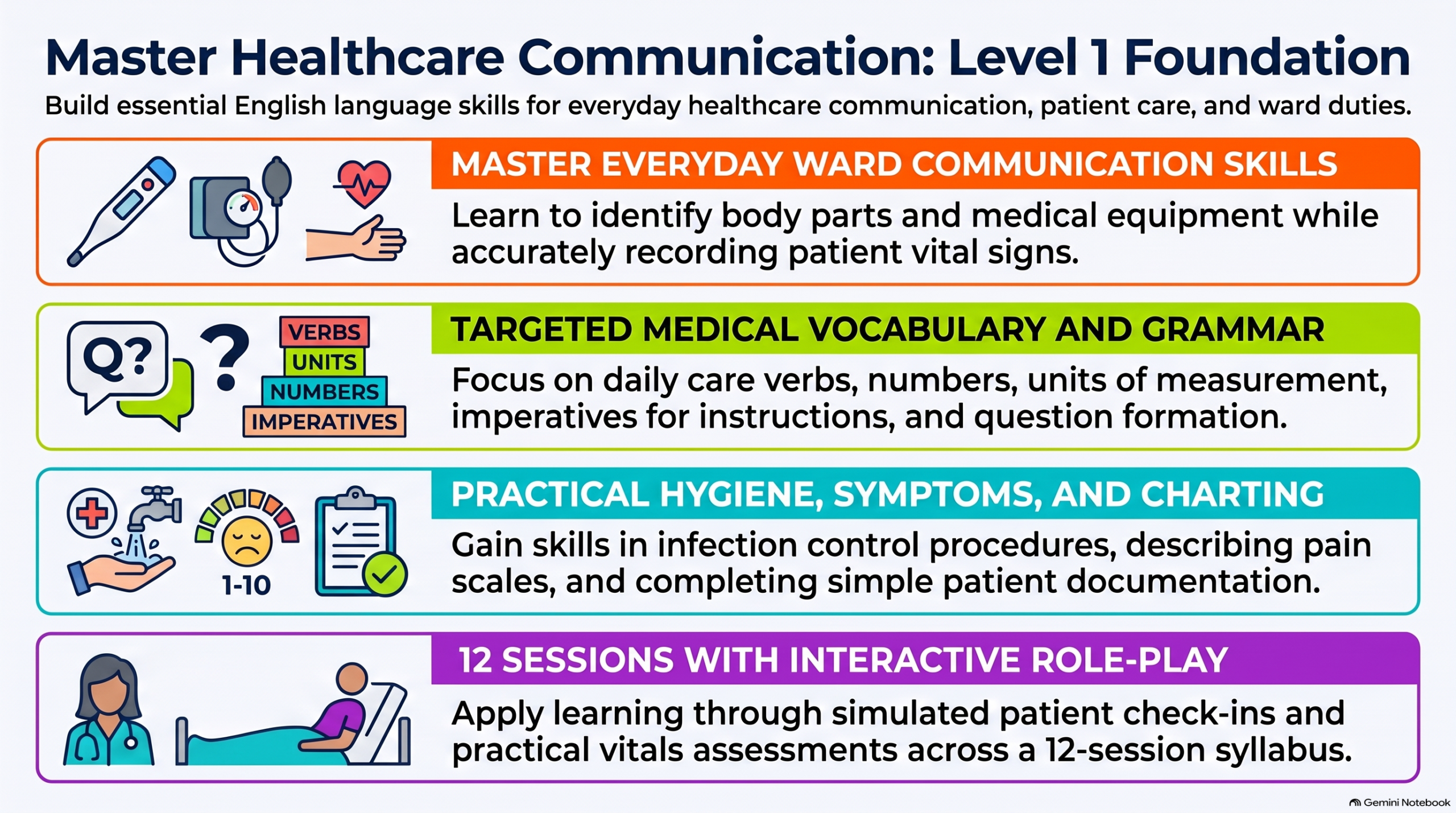
Course Goal: Enable learners to handle everyday ward communication, identify equipment and anatomy, and record basic patient measurements.
Grammar & Vocabulary Focus
- Grammar: Present Simple & Continuous, Imperatives (for instructions), Prepositions of Place/Movement, Basic Question Formation (What, Where, How much/many).
- Vocabulary: Body parts, basic medical equipment, colors/shapes, cardinal/ordinal numbers, units of measurement, daily care verbs (wash, feed, move, check).
12-Session Syllabus (2 Hours Each)
- Session 1: Welcome to the Ward & The Nursing Team
- Vocab: Hospital departments, healthcare roles (nurse, doctor, orderly, unit manager).
- Grammar: Present simple (I work in Cardiology, She checks patients).
- Session 2: The Human Body: External Parts
- Vocab: Head, chest, limbs, abdomen, joints.
- Grammar: Describing locations using prepositions (above, below, next to, on the left).
- Session 3: Essential Hospital Equipment
- Vocab: Thermometer, stethoscope, syringe, wheelchair, IV pole, bandage.
- Grammar: This/That/These/Those & Demonstratives (Pass me that syringe).
- Session 4: Taking Vital Signs (Part 1: Temperature & Pulse)
- Vocab: Degrees, Celsius, fast, slow, normal, elevated, bpm.
- Grammar: Numbers & decimals; asking basic questions (What is your temperature?).
- Session 5: Taking Vital Signs (Part 2: Blood Pressure & Respiration)
- Vocab: Systolic, diastolic, breathing, rate, high, low, blood pressure cuff.
- Grammar: Imperatives for giving simple instructions (Sit down, please, Roll up your sleeve).
- Session 6: Mid-Level Review & Practical Role-Play (Vitals Check)
- Practice: Interactive assessment on taking a complete set of vital signs in English.
- Session 7: Hygiene and Infection Control
- Vocab: Handwashing, gloves, mask, gown, sterile, sanitize, soap.
- Grammar: Frequency adverbs (always wash hands, never reuse gloves).
- Session 8: Daily Patient Care & Routines
- Vocab: Bathing, feeding, changing sheets, mobility, repositioning.
- Grammar: Present Continuous (Mr. Smith is resting now, I am changing the dressing).
- Session 9: Describing Basic Symptoms & Pain (Part 1)
- Vocab: Pain scale (1–10), sharp, dull, sore, hot, cold.
- Grammar: Asking How do you feel? / Where does it hurt?.
- Session 10: Food, Nutrition, and Patient Diets
- Vocab: Liquid diet, diabetic, low-sodium, allergy, breakfast/lunch/dinner trays.
- Grammar: Countable and uncountable nouns (some water, an apple, much pain).
- Session 11: Simple Charting & Documentation
- Vocab: Intake, output, chart, time, signature, notes.
- Grammar: Basic past simple for completed actions (Patient ate lunch at 12:00).
- Session 12: Final Role-Play & Level 1 Assessment
- Evaluation: Simulated patient check-in and vital signs assessment.
Level 2: Intermediate Nursing Communication (B1)
Course Goal: Build fluency in taking patient histories, describing symptoms accurately, explaining medical procedures, and giving clear shift handovers.
Grammar & Vocabulary Focus
- Grammar: Past Simple vs. Present Perfect, Modals of Necessity & Obligation (must, should, need to), Comparative/Superlative adjectives, Time clauses (before, after, while).
- Vocabulary: Internal organs, common medical conditions, symptoms, dosage/medication terms, pain descriptors, administrative nursing terms.
12-Session Syllabus (2 Hours Each)
- Session 1: Patient Admission & Personal History
- Vocab: Next of kin, emergency contact, marital status, occupation, medical history.
- Grammar: Open vs. closed questions for gathering patient details.
- Session 2: Internal Body Systems & Anatomy
- Vocab: Lungs, heart, stomach, liver, kidneys, intestines, veins, arteries.
- Grammar: Describing functions (The heart pumps blood…).
- Session 3: Pain Assessment in Depth
- Vocab: Throbbing, burning, aching, shooting, intermittent, constant, mild, severe.
- Grammar: Present Perfect for duration (How long have you had this pain?).
- Session 4: Explaining Common Nursing Procedures
- Vocab: Blood test, IV insertion, X-ray, ECG, urine sample.
- Grammar: Sequence markers (First, then, after that, finally).
- Session 5: Administering Medications & Dosages
- Vocab: Oral, IV, topical, dosage, mg, ml, side effects, twice daily (BID), as needed (PRN).
- Grammar: Expressing obligation & permission (You must take this with food).
- Session 6: Mid-Level Review & Procedure Demonstration Role-Play
- Practice: Explaining a routine medical procedure step-by-step to a hesitant patient.
- Session 7: Shift Handover Reports (ISBAR Framework Intro)
- Vocab: Shift change, summary, stable, deteriorated, pending labs.
- Grammar: Past simple narrative for summarizing events (Patient reported dizziness at 03:00).
- Session 8: Caring for Elderly & Pediatric Patients
- Vocab: Fall risk, dementia, mobility aids, pediatric growth, gentle phrasing.
- Grammar: Polite requests and soft phrasing (Would you mind… / Could you try to…).
- Session 9: Post-Operative Care & Monitoring
- Vocab: Incision, drainage, stitches, recovery room, nausea, numbness.
- Grammar: First Conditional for warning/reassurance (If you feel nauseous, let me know).
- Session 10: Standardized Documentation & Charting (SBAR Basics)
- Vocab: Situation, Background, Assessment, Recommendation.
- Grammar: Concise reporting register and passive voice intro (Medication was administered).
- Session 11: Handling Mild Patient Complaints & Anxiety
- Vocab: Worry, delay, complaint, comfort, reassure, supervisor.
- Grammar: Modals of possibility and reassuring language (It can take a few minutes…).
- Session 12: Level 2 Final Assessment: Complete Shift Handover & Patient Interaction
- Evaluation: Delivering a 3-minute oral handover and handling a patient scenario.
Level 3: Upper-Intermediate Professional & Clinical English (B2)
Course Goal: Mastery of complex patient communication, empathetic response, emergency protocols, interdisciplinary discussions, and discharge planning.
Grammar & Vocabulary Focus
- Grammar: Passive Voice for official/medical reporting, Conditionals (2nd & 3rd) for hypothetical medical cases, Indirect/Reported Speech, Advanced Modal Verbs (might have, should be monitored).
- Vocabulary: Specialized conditions, psychological/emotional terms, triage terminology, pharmacology details, interprofessional communication jargon.
12-Session Syllabus (2 Hours Each)
- Session 1: Advanced Patient Intake & Triage Assessment
- Vocab: Acuity, urgent, non-urgent, trauma, priority, chief complaint.
- Grammar: Reported speech for summarizing patient statements (Patient stated that…).
- Session 2: Empathy, Active Listening, and Soft Skills
- Vocab: Compassion, support, active listening, validation, emotional distress.
- Grammar: Nuanced empathetic structures (I understand how concerning this must feel).
- Session 3: Emergency Nursing & Code Blue Responses
- Vocab: Cardiac arrest, crash cart, defibrillator, airway, resuscitation, shock.
- Grammar: Imperatives under pressure, clear, rapid, direct passive commands.
- Session 4: Communicating Bad News & Sensitive Information
- Vocab: Diagnosis, prognosis, supportive care, quiet room, family conference.
- Grammar: Euphemisms, cushioning techniques, cautious language (It appears that…).
- Session 5: Interprofessional Communication (MDs, Therapists, Social Work)
- Vocab: Multidisciplinary team, referral, consultation, physical therapy, discharge planning.
- Grammar: Professional negotiation register (I recommend we consider…).
- Session 6: Mid-Level Review: Emergency Simulation & Team Handoff
- Practice: High-stress clinical simulation and rapid SBAR escalation.
- Session 7: Patient Education & Chronic Disease Management
- Vocab: Diabetes management, hypertension, lifestyle changes, compliance, self-care.
- Grammar: Complex conditional structures (If you notice swelling, you should immediately…).
- Session 8: Mental Health & Psychiatric Nursing Communication
- Vocab: Anxiety, depression, agitation, orientation, safety plan, restraint policy.
- Grammar: De-escalation phrasing and non-judgmental questioning techniques.
- Session 9: Discharge Planning & Instructions
- Vocab: Home care, follow-up appointment, prescriptions, restrictions, red-flag symptoms.
- Grammar: Future forms & clear step-by-step conditional guidance.
- Session 10: Nursing Ethics, Informed Consent, and Patient Rights
- Vocab: Autonomy, consent form, refusal, confidentiality, HIPAA/privacy guidelines.
- Grammar: Expressing rights, obligations, and legal boundaries in health settings.
- Session 11: Advanced Clinical Charting & Incident Reporting
- Vocab: Adverse event, medication error, incident report, root cause, narrative log.
- Grammar: Formal written register and objective passive reporting.
- Session 12: Final Capstone Assessment: Clinical Simulation & Professional Portfolio
- Evaluation: Full multi-stage assessment (Triage – Patient Care/Empathy – Emergency Response – Written Incident Report).
Pedagogical Methodology & Teaching Tools
- The 3P Approach (Presentation, Practice, Production): Every 2-hour session contains 30 mins presentation, 45 mins controlled/guided practice, and 45 mins realistic role-play/production.
- Task-Based Learning (TBL): Activities are structured around real nursing tasks (e.g., measuring blood pressure while conversing, writing an SBAR report).
- Authentic Materials: Utilization of actual hospital charts, SBAR forms, medical intake questionnaires, and clinical dialog transcripts.