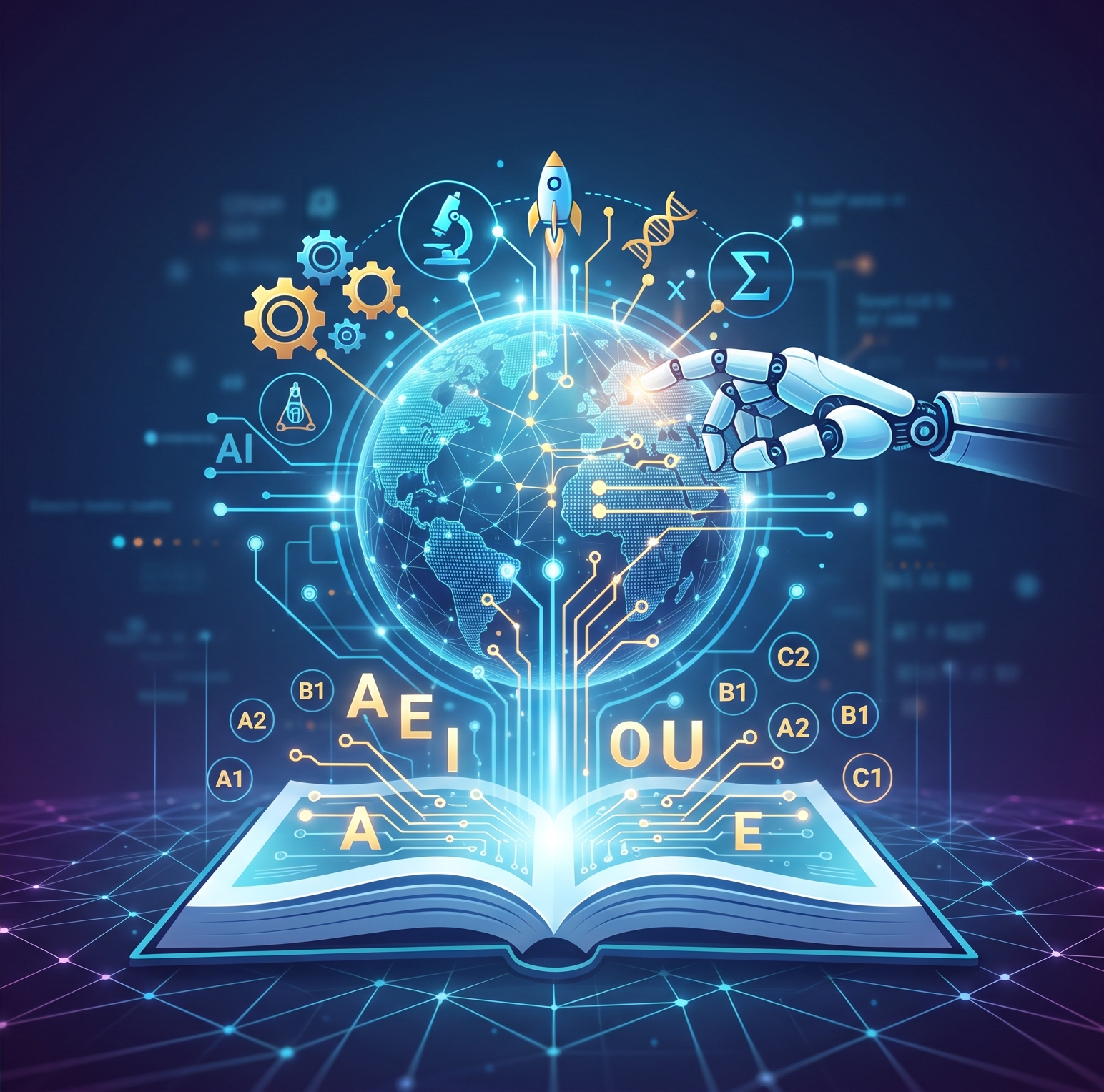
The educational landscape in Egypt is undergoing a profound transformation. For decades, the pedagogical standard was defined by rote memorization and passive learning. However, as we witness the rapid rise of artificial intelligence, a new paradigm is emerging. At Beacon Academy, we believe that the integration of AI-driven tools into English curricula is not merely an innovation; it is a necessity for students who aim to compete in a global, tech-centric economy. By replacing outdated methods with dynamic, personalized learning, we are witnessing a shift toward a more effective, CEFR-aligned educational model.
The Role of AI in Diagnostic Precision
One of the most significant advantages of AI integration is the ability to provide real-time, diagnostic feedback. In a traditional classroom, a teacher may struggle to assess the specific grammatical and lexical weaknesses of thirty students simultaneously. With AI-driven systems, students can receive immediate insights into their writing and speaking patterns. This level of precision allows for true personalized language training, where the curriculum adapts to the learner’s specific pace. By identifying gaps in real-time, students can spend more time on areas where they struggle, ensuring they meet the standards required for their next CEFR level without the frustration of generic exercises.
STEM Vocabulary and Project-Based Learning
When English is taught in isolation, students often struggle to apply the language to complex, real-world scenarios. By adopting a STEM-integrated approach, we contextualize English within science, technology, engineering, and mathematics. In this environment, vocabulary acquisition is driven by necessity. For instance, when a student researches robotics, they must learn technical terminology to complete their project. This project-based learning model ensures that the language is not just memorized, but internalized. This active use of English turns a passive subject into a functional tool, significantly increasing long-term retention rates across our entire student cohort.
Tracking Progress with CEFR Benchmarks
A common critique of tech-heavy learning is the lack of standardized progress measurement. However, at EnglishHub.uk, we have implemented a framework that uses AI to map all student outcomes directly to the Common European Framework of Reference for Languages (CEFR). Whether a student is navigating A1-level communication or C2-level mastery, AI acts as an objective auditor. By tracking these benchmarks, we can provide both students and parents with clear, data-driven proof of progress. This objective oversight ensures that our academic standards remain high and that every student is on a clear trajectory toward their individual goals.
The Teacher as an Academic Facilitator
A primary concern among educators is the potential for technology to replace the human element of instruction. We argue the opposite: AI serves as a powerful instrument that elevates the role of the teacher. By automating administrative tasks and routine grading, AI allows teachers to move away from being simple information providers and evolve into academic facilitators. This shift is vital for the professional growth for educators. When teachers are no longer burdened by repetitive assessment, they can focus on mentorship, emotional intelligence, and complex problem-solving. This human-centric approach is precisely why we advocate for The TE@CHERS Club—a space where educators learn to leverage technology to create high-impact, personalized learning environments.
Addressing the Skepticism
Some critics argue that an over-reliance on AI might diminish a student’s ability to engage in critical thinking or authentic self-expression. They worry that if the machine corrects the grammar, the student might lose the desire to learn the underlying rules. While this is a valid concern, our model addresses it by utilizing AI as a reflective tool rather than a replacement for effort. The AI does not write the essay; it audits it, challenging the student to improve their coherence and argument structure. The critical thinking remains the student’s responsibility; the AI merely provides the structured feedback necessary for them to refine their own work.
Conclusion: A Reflective Path Forward
The future of STEM education is inextricably linked to our ability to embrace intelligent, adaptive learning technologies. By moving toward a model that prioritizes individual proficiency and teacher facilitation, we are preparing the next generation of Egyptian leaders for the global stage.
Before you move on, take a moment to reflect on your own learning journey:
- If you are a student: How has your approach to complex problem-solving changed when you use technology to audit your own work? Are you merely fixing errors, or are you actively learning the underlying structural rules?
- If you are an educator: How can you shift your classroom focus from being the primary source of information to becoming a facilitator of your students’ autonomous growth? What is one administrative task currently consuming your time that could be automated to allow for more mentorship?
Reflecting on these questions is the first step toward true academic and professional evolution. Whether you are a student striving for mastery or an educator dedicated to professional growth, the integration of these tools is a deliberate choice. We invite you to join the ESL Le@rners Club to continue applying these concepts in a structured environment, or connect with your peers in The TE@CHERS Club to share your reflections on building the future of education.