The Big Idea
Think about the devices in your home: lights, air conditioners, watches, and doorbells. In the past, these were simple tools that required a human to flip a switch. Today, these everyday objects are getting smarter. The Internet of Things, or IoT, describes the growing network of physical objects that contain sensors, software, and wireless connections, allowing them to collect and share data automatically.
How It Works
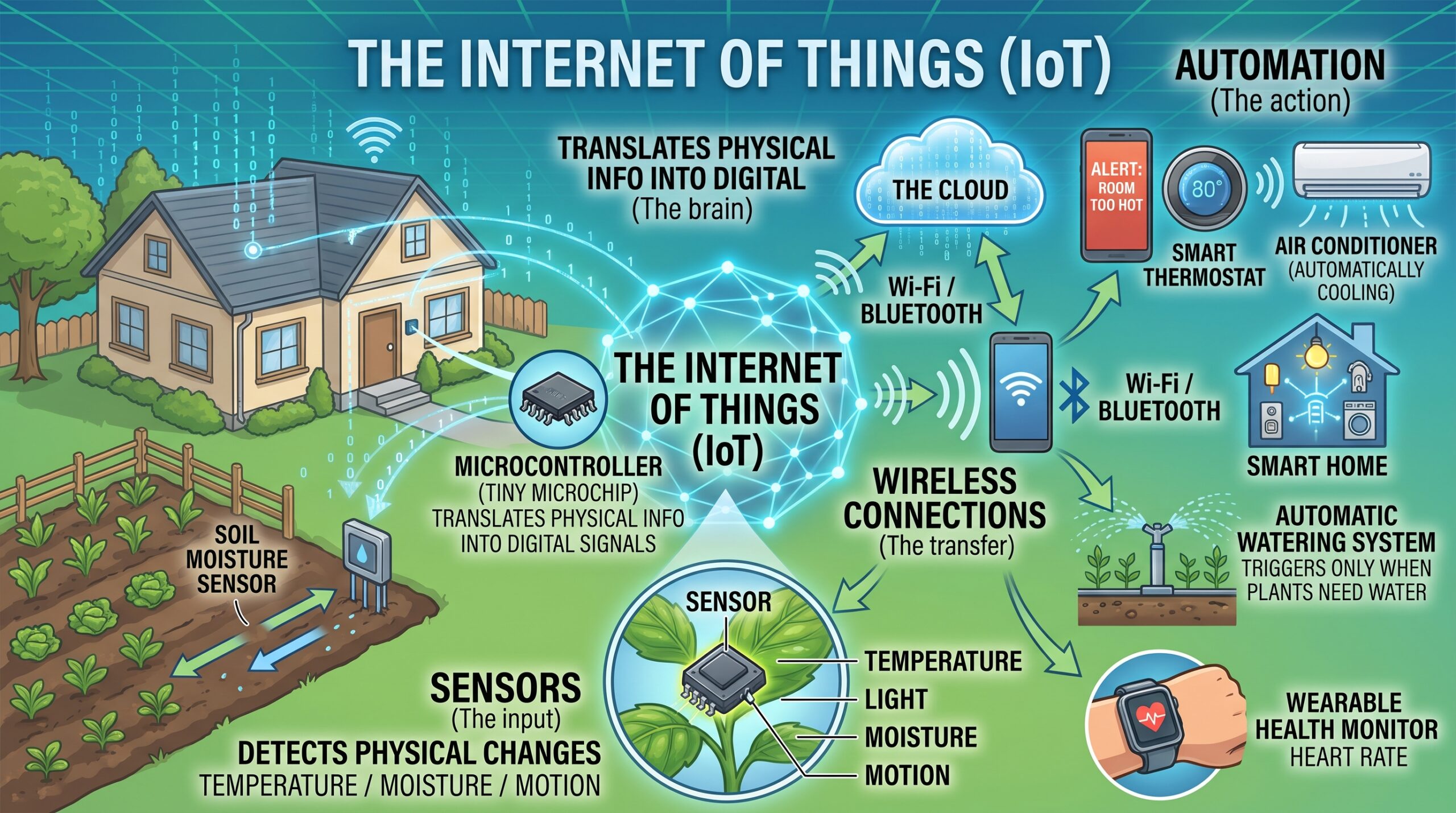
The foundation of any IoT device is the sensor. A sensor is an electronic component that detects physical changes in its environment, such as changes in temperature, light intensity, pressure, moisture, or motion. For example, a smart thermostat uses thermal sensors to measure room temperature.
Once the sensor collects this physical information, a tiny microchip translates it into digital signals. The device then uses Wi-Fi, Bluetooth, or mobile networks to transmit that data to the cloud or to an app on your phone. If the sensor detects that your living room is getting too hot, it sends an alert to your smartphone or automatically instructs the air conditioner to turn on. In modern agriculture, IoT soil sensors measure moisture levels in fields and trigger automatic watering systems only when plants actually need water.
Why It Matters
IoT technology saves energy, reduces waste, and makes cities safer. Smart streetlights dim when streets are empty to conserve electricity, and wearable health monitors track heart rates and detect falls in elderly patients, sending emergency medical help instantly.
Key Vocabulary
- Sensor: A device that detects physical inputs like heat, motion, light, or pressure.
- Microcontroller: A compact integrated circuit designed to govern an operation in an embedded system.
- Automation: Using technology to perform tasks with minimal human intervention.