The Big Idea
Computers are fantastic at following strict, exact instructions. If you tell a calculator to multiply two large numbers, it does so instantly. However, human thinking is different; we learn from experience, recognize faces, and adapt when situations change. Artificial Intelligence, or AI, is a branch of computer science that builds computer software capable of performing tasks that normally require human intelligence.
How It Works
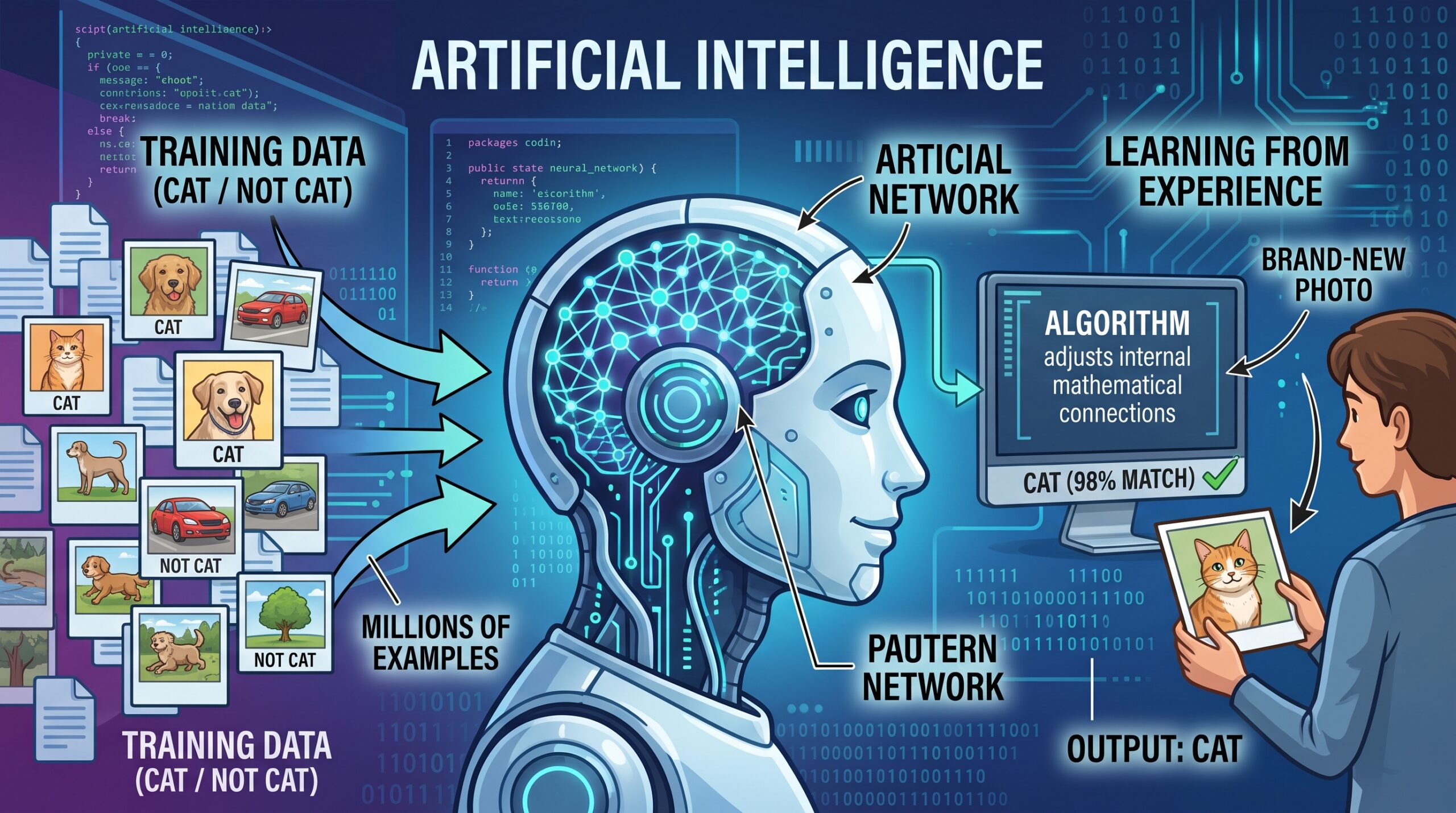
Traditional software works using rigid rules: “If X happens, do Y.” But modern AI relies heavily on a technique called machine learning. Instead of writing every single rule by hand, software engineers feed an algorithm thousands or millions of examples, known as training data.
For instance, to teach an AI system to recognize a cat, engineers do not explain what whiskers or fur look like in code. Instead, they upload millions of photos labeled “cat” and “not cat.” The machine learning model, often built using an artificial neural network inspired by the human brain, analyzes the images. It looks for patterns, edges, and shapes. Over time, the model adjusts its internal mathematical connections. When you show it a brand-new photo it has never seen before, it can accurately identify whether a cat is present.
Why It Matters
AI technology is transforming every industry. Doctors use it to detect medical problems in X-rays faster than ever before. Autonomous self-driving cars use AI to detect pedestrians and stay safely inside traffic lanes. It also powers language translation tools, helping people from different countries communicate smoothly.
Key Vocabulary
- Algorithm: A set of mathematical steps or rules given to a computer to solve a problem.
- Training Data: Large collections of information used to teach machine learning models.
- Neural Network: A computer system modeled on the human brain to detect patterns.