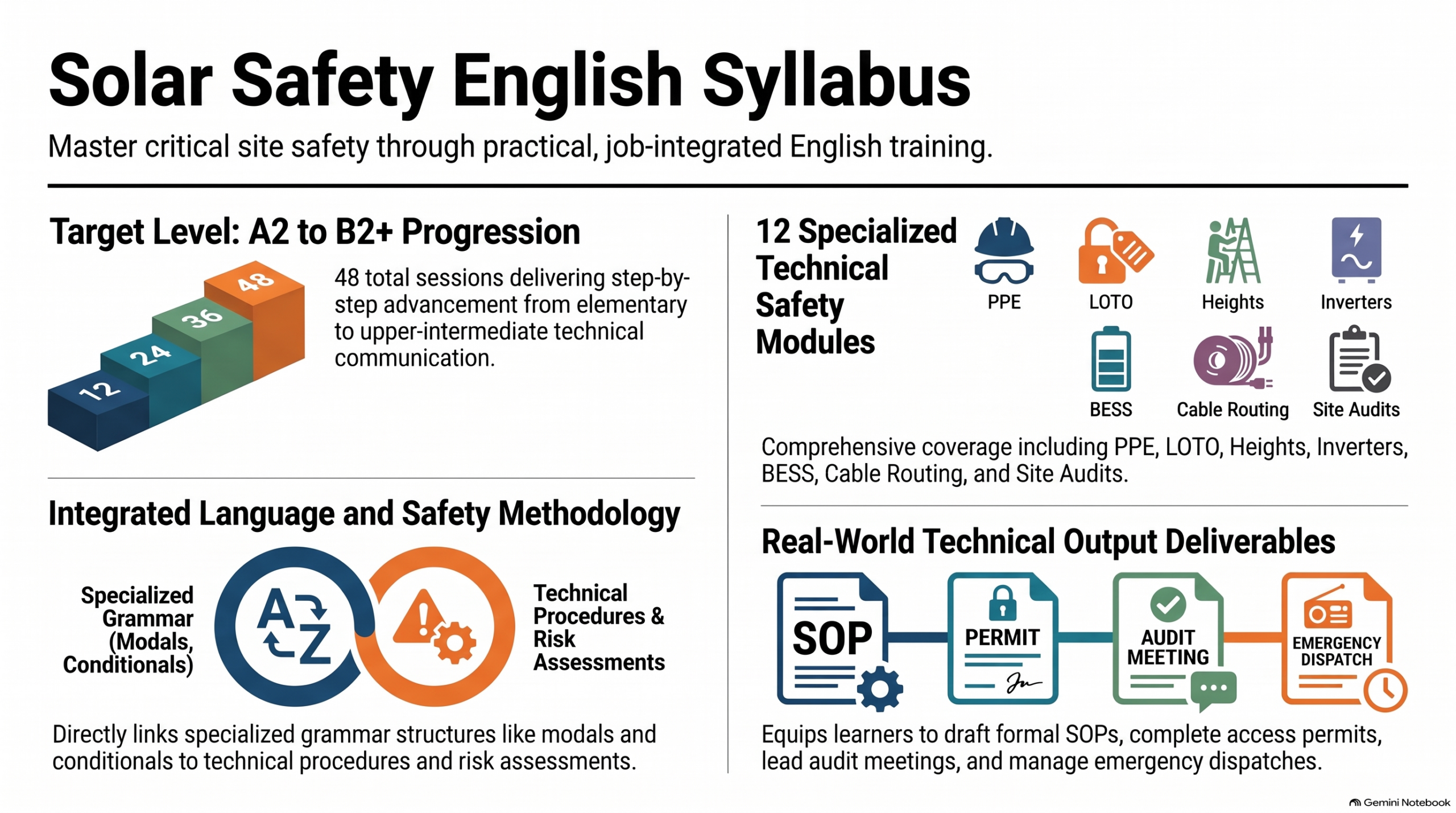
Target Audience: A2 (Elementary) Learners moving toward B2+ (Upper-Intermediate)
Total Course Duration: 12 Units | 48 Sessions (4 $\times$ 60-minute sessions per unit)
Methodology: Task-Based Learning (TBL), Content and Language Integrated Learning (CLIL), and Contextual Technical Grammar Extraction.
Unit 1: Site Orientation, Personal Protective Equipment (PPE) & Hazard Identification
Unit Description
This unit introduces trainees to utility-scale and commercial solar job sites. Learners acquire foundational safety terminology, understand site orientation protocols, and master the language required to identify hazards and enforce PPE compliance.
Learning Objectives
- Vocabulary Objectives:
- Define and correctly apply essential PPE terms: Personal Protective Equipment (PPE), photovoltaic (PV) module, insulated gloves, dielectric safety boots, arc flash, hazard identification, de-energize, and fall arrest harness.
- Identify PPE safety ratings (e.g., Class 0, Class E, cal/cm²).
- Reading Objectives:
- Comprehend technical site orientation texts and safety rules.
- Extract specific details regarding mandatory gear and immediate hazard reporting steps.
- Grammar Objectives:
- Master Modals and Semi-Modals of Obligation, Prohibition, and Capability (must, must not, have to, be required to, can, should).
- Express mandatory workplace rules versus best practices in technical contexts.
- Listening Objectives:
- Understand spoken site safety toolbox talks delivered by a Site Safety Officer (SSO).
- Identify explicit verbal warnings, required PPE items, and daily job instructions.
- Speaking Objectives:
- Conduct a pre-shift safety inspection roleplay between a supervisor and an installer.
- Verbally enforce PPE compliance and articulate site hazard risks.
- Writing Objectives:
- Draft a formal Hazard Identification Report (100–120 words) detailing unsafe conditions and mandatory corrective actions.
Unit 2: Electrical Safety, Lockout/Tagout (LOTO) & System Isolation
Unit Description
Focuses on electrical hazards associated with high-voltage direct current (DC) and alternating current (AC) systems. Learners study zero-energy verification procedures, lockout/tagout (LOTO) protocols, and safe electrical boundary management.
Learning Objectives
- Vocabulary Objectives:
- Acquire specialized isolation terminology: disconnect switch, digital multimeter, busbar, residual voltage, tagout hasp, lockout padlock, isolation point, and energized circuit.
- Reading Objectives:
- Read and interpret Standard Operating Procedures (SOPs) for LOTO and electrical system de-energization.
- Trace sequential isolation steps in technical manuals.
- Grammar Objectives:
- Formulate Imperatives and Sequential Discourse Markers (First, disconnect… Next, attach… Never touch… Finally, verify…).
- Structure clear, step-by-step technical instructions.
- Listening Objectives:
- Comprehend audio recordings of LOTO verification audits and safety supervisor instructions.
- Identify procedural errors mentioned in spoken audit reviews.
- Speaking Objectives:
- Perform a step-by-step verbal LOTO walkthrough with a partner before opening switchgear cabinets.
- Explain isolation procedures to a junior technician.
- Writing Objectives:
- Write a formal step-by-step LOTO Standard Operating Procedure (SOP) notice for posting on switchgear cabinets.
Unit 3: Working at Heights, Scaffolding & Fall Protection Systems
Unit Description
Addresses the mechanical and structural risks of installing PV arrays on elevated structures, commercial roofs, and mounting scaffolds. Covers fall protection equipment, anchor points, and roof safety protocols.
Learning Objectives
- Vocabulary Objectives:
- Master terms related to working elevated: safety lanyard, D-ring, certified anchor point, static life-line, scaffolding, toe-board, suspension trauma, and edge protection.
- Reading Objectives:
- Analyze rooftop access safety guidelines, fall protection plans, and wind-loading safety thresholds.
- Understand site clearance certificates for elevated working platforms.
- Grammar Objectives:
- Differentiate between Present Continuous for Ongoing Site Actions (The crew is securing the anchor lines) and Present Simple for Permanent Safety Rules (Technicians always wear harnesses above 2 meters).
- Listening Objectives:
- Follow audio instructions during a rooftop pre-climb safety briefing.
- Recognize spoken warnings about sudden wind gusts and unanchored materials.
- Speaking Objectives:
- Carry out a pre-climb harness and lanyard inspection dialogue.
- Verbally refuse unsafe elevated work assignments using appropriate safety terminology.
- Writing Objectives:
- Complete a formal Working at Heights Access Permit and safety inspection log.
Unit 4: Tools, Measuring Instruments & Equipment Safety
Unit Description
Teaches the correct terminology, calibration procedures, and safe operation of specialized electrical measuring tools, insulated hand tools, and heavy mechanical lifting equipment on solar sites.
Learning Objectives
- Vocabulary Objectives:
- Learn equipment and instrument terminology: digital multimeter, DC clamp meter, calibrated torque wrench, insulation resistance tester (Megger), mobile crane, boom lift, and calibration sticker.
- Reading Objectives:
- Read technical instruction manuals, tool safety inspection sheets, and calibration certificates.
- Extract torque specifications and meter category ratings (CAT III / CAT IV).
- Grammar Objectives:
- Apply Passive Voice in Present Simple for formal technical processes (Voltage is measured across the terminals; torque settings are checked by the quality engineer).
- Listening Objectives:
- Understand spoken equipment inspection logs and tool issue notifications from site storekeepers.
- Identify faulty instrument reports in acoustic audio clips.
- Speaking Objectives:
- Request equipment calibration or replacement in a professional dialogue with a tool room manager.
- Explain how to safely operate a digital multimeter in CAT IV environments.
- Writing Objectives:
- Write an official Equipment Defect & Requisition Log entry describing damaged or uncalibrated tools.
Unit 5: Photovoltaic Module Handling & Structural Racking Safety
Unit Description
Covers safe physical handling, transport, mounting, and structural mechanical alignment of solar PV modules. Focuses on preventing module damage, micro-cracks, and structural failure.
Learning Objectives
- Vocabulary Objectives:
- Master structural and material terms: micro-cracks, glass delamination, junction box strain, ballast tray, torque specification, wind load, frame alignment, and clamping zone.
- Reading Objectives:
- Read solar module installation manuals, mechanical racking schematics, and manufacturer warranty constraint sheets.
- Grammar Objectives:
- Contrast Past Simple for Completed Site Incidents (A module dropped yesterday) with Present Perfect for Current Site Status (The team has already mounted 50 panels).
- Listening Objectives:
- Process audio debriefs regarding damaged module shipments and installation errors.
- Identify specific quantities, panel serial numbers, and damage types from spoken reports.
- Speaking Objectives:
- Report damaged panel shipments to a logistics supervisor.
- Give clear physical directions to an installation team mounting racking structures.
- Writing Objectives:
- Write a formal Material Damage Claim Report detailing physical defects found on delivered PV modules.
Unit 6: Inverter Operations, High-Voltage Cabinets & Grid Interface
Unit Description
Focuses on the high-voltage operational hazards of central and string inverters, step-up transformers, and the main grid interconnection interface.
Learning Objectives
- Vocabulary Objectives:
- Learn high-voltage inverter vocabulary: central inverter, string inverter, step-up transformer, DC disconnect switch, heat sink, capacitor bank discharge, grid synchronization, and anti-islanding.
- Reading Objectives:
- Interpret high-voltage warning signs, inverter diagnostic status displays, and grid connection protocol documents.
- Grammar Objectives:
- Construct First Conditional Sentences for Real Operational Consequences (If you open the cabinet door while energized, the main circuit breaker will trip).
- Listening Objectives:
- Understand complex spoken technical briefings about inverter commissioning and grid synchronization procedures.
- Identify spoken alarm codes and error descriptions.
- Speaking Objectives:
- Explain inverter status light codes and necessary safety precautions to a field technician.
- Participate in a grid-connection safety readiness discussion.
- Writing Objectives:
- Draft an Inverter Fault & Isolation Notice to be placed on an out-of-service central inverter unit.
Unit 7: Battery Energy Storage Systems (BESS) & Chemical Safety
Unit Description
Covers the specialized safety requirements for utility-scale Battery Energy Storage Systems (BESS), including chemical exposure, thermal runaway risks, off-gassing, and fire suppression systems.
Learning Objectives
- Vocabulary Objectives:
- Master energy storage safety terms: lithium-ion battery, thermal runaway, off-gassing, gas detection system, Battery Management System (BMS), electrolyte leak, clean-agent fire suppression, and containment area.
- Reading Objectives:
- Read Safety Data Sheets (SDS) for battery chemistries and technical manuals for BESS fire suppression systems.
- Grammar Objectives:
- Use Second Conditional for Hypothetical Safety Scenarios (If thermal runaway occurred in Container A, the automatic gas suppression system would activate immediately).
- Listening Objectives:
- Understand emergency alarm notifications and spoken BESS safety protocols during simulated chemical or fire incidents.
- Speaking Objectives:
- Explain BESS emergency shut-off procedures during a site hazard review.
- Discuss hypothetical fire scenarios and response plans with site engineers.
- Writing Objectives:
- Write a Hazardous Material Handling & BESS Safety Log entry outlining risk mitigation measures.
Unit 8: DC/AC Cable Routing, Trenching & Underground Safety
Unit Description
Addresses safety protocols for DC string cable management, cable tray installation, civil underground trenching, heavy machinery operations near buried cables, and conduit routing.
Learning Objectives
- Vocabulary Objectives:
- Acquire cable routing and civil terms: conduit, underground trench, direct burial cable, cable tray, minimum bend radius, pulling tension, cable glands, and underground utility marking.
- Reading Objectives:
- Read civil excavation permits, underground cabling schematics, and cable management guidelines.
- Grammar Objectives:
- Master Prepositions of Place and Movement in Spatial Descriptions (Route the cable through the conduit, under the roadbed, along the cable tray, and into the junction box).
- Listening Objectives:
- Understand spoken instructions given by site civil supervisors regarding excavation boundaries and cable laying speeds.
- Speaking Objectives:
- Direct equipment operators during trenching around existing underground utilities.
- Describe physical cable routing pathways clearly to an installation crew.
- Writing Objectives:
- Complete a formal Underground Excavation & Trenching Safety Permit.
Unit 9: Thermal Imaging, Commissioning & Quality Inspection
Unit Description
Teaches the language and protocols of quality control, string testing, open-circuit voltage checks, infrared thermography inspection, and final system commissioning safety.
Learning Objectives
- Vocabulary Objectives:
- Learn testing and inspection terms: thermography, infrared camera, thermal hotspot, irradiance meter, open-circuit voltage (Voc), short-circuit current (Isc), commissioning checklist, and string testing.
- Reading Objectives:
- Interpret thermographic inspection reports, string test data sheets, and quality assurance audit checklists.
- Grammar Objectives:
- Master Defining and Non-Defining Relative Clauses (The technician who performed the infrared survey found three hotspots; panels that display thermal hotspots must be isolated immediately).
- Listening Objectives:
- Follow audio discussions between quality control engineers reviewing infrared imaging data.
- Identify specific panel location coordinates and temperature differentials from spoken commentary.
- Speaking Objectives:
- Present thermal inspection findings to a site manager and recommend corrective actions.
- Explain string testing results during a commissioning debrief.
- Writing Objectives:
- Write a formal Commissioning Summary Report summarizing electrical test results and identified array defects.
Unit 10: Arc Flash Protection & Severe Weather Safety Protocols
Unit Description
Focuses on advanced arc flash safety boundary calculations, explosive blast mitigation, and severe weather protocols (high winds, lightning storms, extreme heat).
Learning Objectives
- Vocabulary Objectives:
- Master severe weather and arc flash terms: arc flash boundary, incident energy (cal/cm²), arc blast, lightning protection system, wind gust threshold, heat exhaustion, and site stand-down.
- Reading Objectives:
- Read arc flash hazard labels, weather stand-down policy documents, and site emergency weather protocols.
- Grammar Objectives:
- Use Third Conditional and Past Modals for Incident Analysis (If the crew had checked the anemometer, they would not have attempted the panel lift; the supervisor should have ordered a site stand-down).
- Listening Objectives:
- Understand emergency weather stand-down announcements broadcast over site radio channels.
- Speaking Objectives:
- Debrief a safety incident involving severe weather or arc flash exposure.
- Justify an immediate work stoppage order due to extreme weather conditions.
- Writing Objectives:
- Draft a Weather-Related Work Suspension Report outlining weather metrics and safety actions taken.
Unit 11: Emergency Response, First Aid & Fire Fighting on Solar Sites
Unit Description
Covers technical language and action plans for responding to site emergencies, including electrical shock casualties, fires in energized equipment, site evacuations, and emergency services coordination.
Learning Objectives
- Vocabulary Objectives:
- Acquire emergency terminology: Class C fire extinguisher, cardiopulmonary resuscitation (CPR), electric shock, muster point, evacuation route, Emergency Stop (E-Stop), first responder, and burn treatment.
- Reading Objectives:
- Read Emergency Response Plans (ERP), site evacuation maps, and emergency medical procedures.
- Grammar Objectives:
- Apply Reported Speech in Technical Emergency Statements (The electrician reported that the E-stop had been activated; the paramedic stated that the victim was conscious).
- Listening Objectives:
- Understand rapid emergency phone calls, dispatch messages, and public address evacuation announcements.
- Extract critical information (location, casualty count, hazard type) from fast spoken dialogue.
- Speaking Objectives:
- Call 911 or emergency dispatchers to report a severe site incident clearly and concisely.
- Coordinate a team during a simulated site emergency evacuation drill.
- Writing Objectives:
- Complete an Emergency Evacuation Log and First Aid Incident Report.
Unit 12: Site Safety Audits, Incident Reporting & Compliance Management
Unit Description
Synthesizes all technical safety skills learned throughout the course. Learners focus on root cause analysis, legal compliance audits (OSHA/IEC standards), corrective action tracking, and formal incident reporting.
Learning Objectives
- Vocabulary Objectives:
- Master compliance and audit terminology: OSHA compliance, regulatory audit, root cause analysis (RCA), corrective action plan, near-miss incident, non-compliance citation, and contributory negligence.
- Reading Objectives:
- Read complex regulatory safety audit reports, legal safety compliance standards, and detailed incident investigations.
- Grammar Objectives:
- Use Complex Linking Words and Discourse Markers for Formal Analysis (Furthermore, consequently, however, in order to, despite, as a result of).
- Listening Objectives:
- Understand a closing interview between a government regulatory safety auditor and site management.
- Identify cited violations and required remediation timelines from spoken remarks.
- Speaking Objectives:
- Defend site safety compliance in a formal audit meeting with regulatory inspectors.
- Lead a Root Cause Analysis (RCA) meeting to investigate a near-miss event.
- Writing Objectives:
- Write a comprehensive, multi-paragraph Incident Root Cause Analysis (RCA) Report (180–220 words) detailing an event, underlying causes, and mandatory corrective actions.