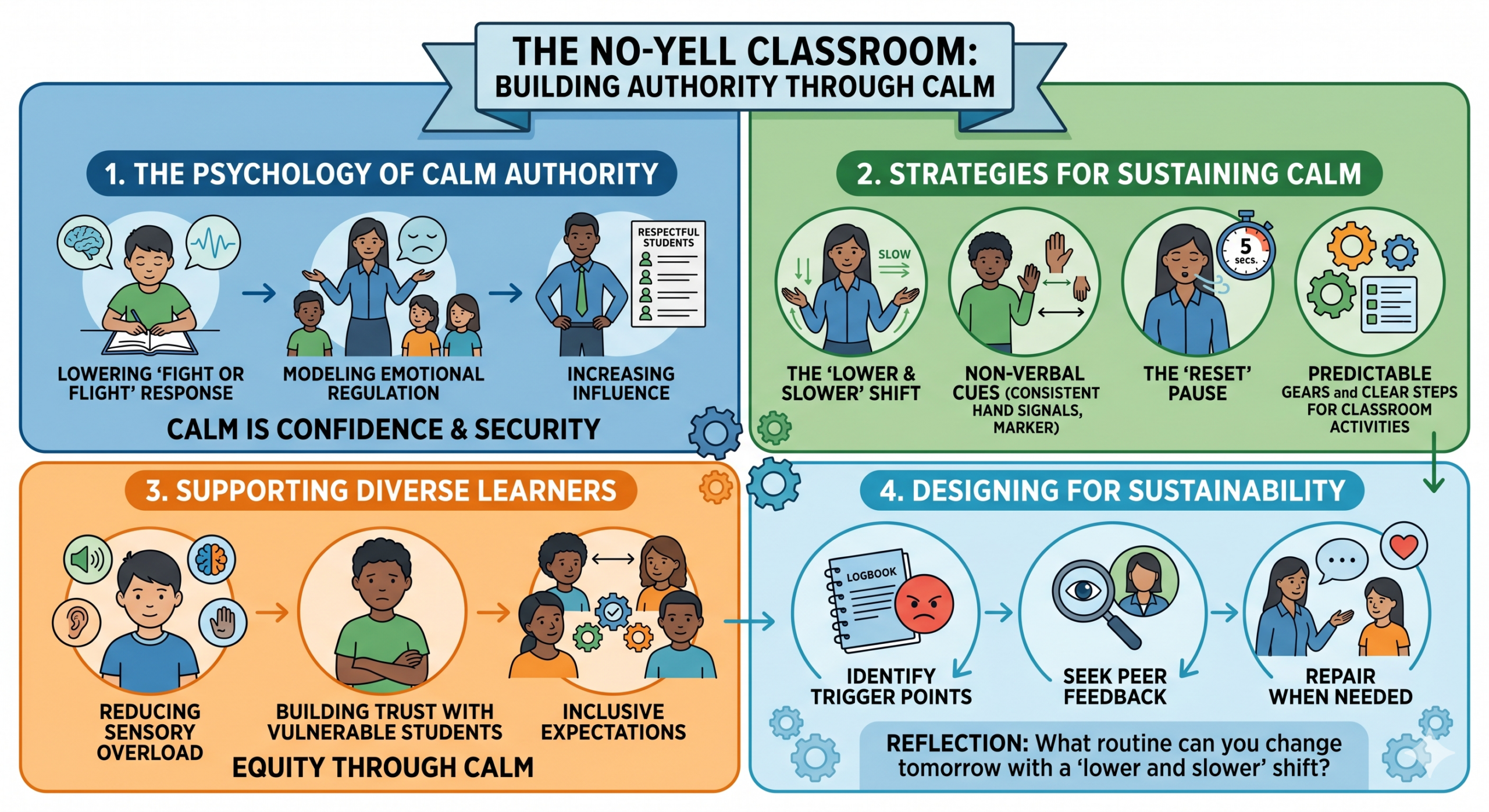
Establishing a “No-Yell” classroom is not about being passive; it is a deliberate strategy to build authority through consistency, emotional regulation, and intentional communication. By choosing calm over volume, educators create a predictable environment where students feel safe and more inclined to focus on learning rather than reacting to the teacher’s emotional state.
1. The Psychology of Calm Authority
Volume and emotional intensity can often be perceived as a loss of control, whereas calm is a signal of confidence and security.
- Lowering the “Fight or Flight” Response: Yelling activates a student’s sympathetic nervous system, causing them to focus on survival or defense rather than the content being taught.
- Modeling Emotional Regulation: When a teacher remains calm during frustration, they are actively teaching students how to manage their own emotions during difficult moments.
- Increasing Influence: Students are more likely to respect and follow directives from a teacher who communicates with measured, intentional energy than one who relies on volume to gain attention.
2. Strategies for Sustaining Calm
| Strategy | Implementation Tip |
| The “Lower and Slower” Shift | When tension rises, intentionally lower the pitch of your voice and speak more slowly; this naturally forces you to regulate your own physical state. |
| Non-Verbal Cues | Use consistent hand signals or physical placement (proximity) to manage behavior rather than speaking over the noise. |
| The “Reset” Pause | If you feel your own frustration reaching a tipping point, use a 5-second pause to breathe and realign before speaking. |
| Predictable Routines | Clear, well-practiced routines reduce the ambiguity that often leads to teacher frustration and subsequent yelling. |
3. Supporting Diverse Learners
A “No-Yell” classroom is essential for equity, as loud reprimands affect students differently based on their backgrounds and neurodiversity.
- Reducing Sensory Overload: For neurodivergent students, loud voices can be physically painful and distracting; maintaining a calm tone keeps the auditory environment manageable.
- Building Trust with Vulnerable Students: Students who may have experienced trauma often associate loud adult voices with danger; calm authority is a prerequisite for building the trust needed for them to learn.
- Inclusive Expectations: Consistency in a calm delivery ensures that all students are held to the same standards without the variability that arises when a teacher’s mood dictates their volume.
4. Designing for Sustainability
Building a calm classroom culture is a professional practice that requires ongoing reflection and self-awareness.
- Identify Your “Trigger” Points: Keep a brief log of moments where you felt the urge to yell; understanding these triggers helps you prepare more effective, calm responses in advance.
- Seek Peer Feedback: Ask a trusted colleague to observe your classroom and provide feedback on your use of voice and non-verbal cues.
- Repair When Needed: If you do lose your cool, apologize and explain your humanness to the students; this builds rapport and demonstrates the very accountability you expect from them.
Reflection
The goal of the “No-Yell” classroom is to create a space where your presence, not your volume, commands respect. What is one routine or transition in your daily schedule that currently feels chaotic, and how could you replace a verbal “call to order” with a non-verbal cue or a “lower and slower” instruction to change the energy tomorrow?
Note: This article is based on general principles of classroom management and emotional regulation.