Giving students the power to choose how they demonstrate their learning can profoundly change the classroom dynamic, moving students from passive compliance to active ownership. Offering “menu-based” assignments—where learners select from a variety of tasks that all meet the same learning objective—is a powerful application of autonomy-supportive pedagogy.
1. The Psychology Behind Choice
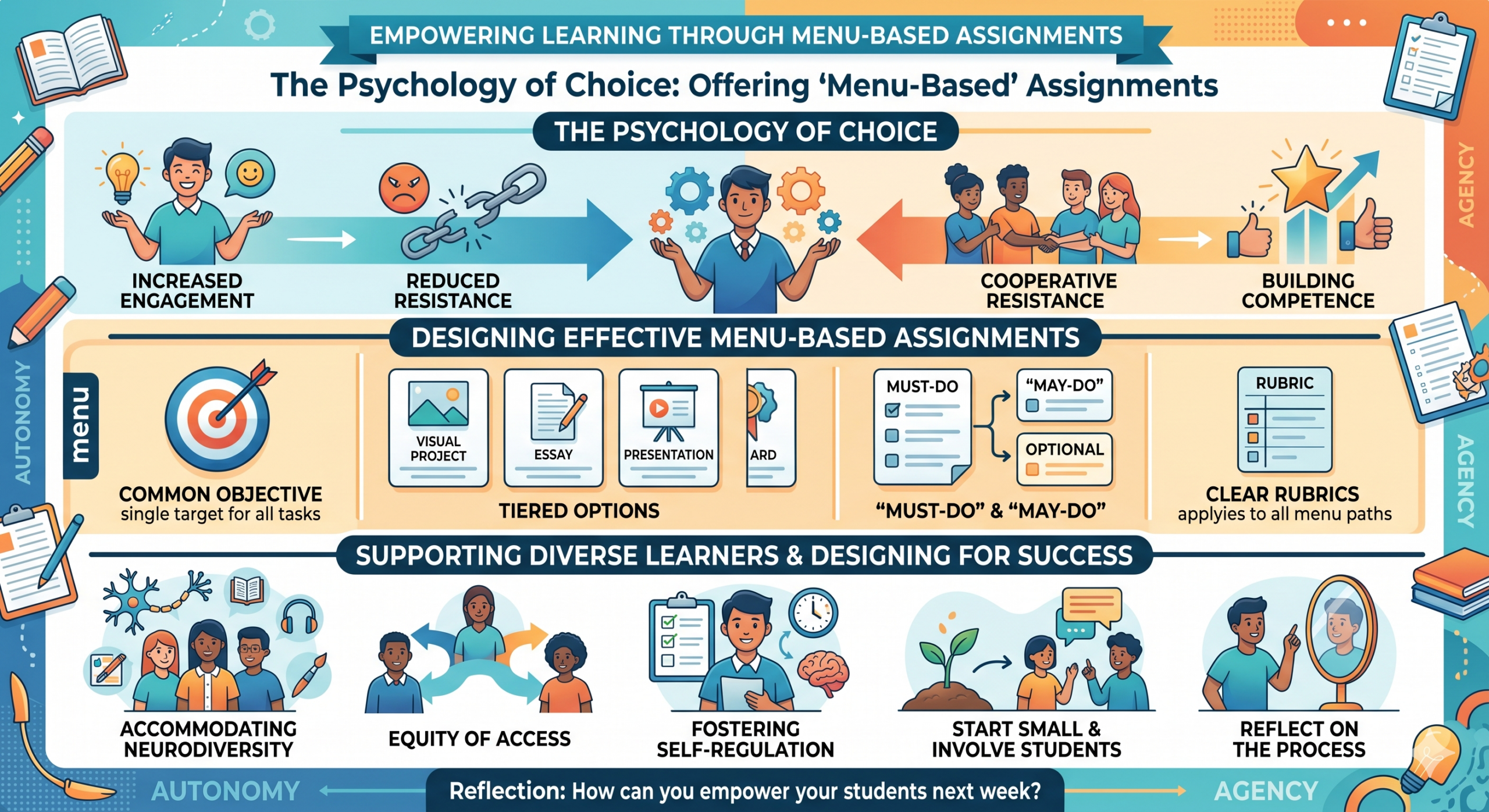
When students are provided with options, they experience a greater sense of autonomy, which is a fundamental human need.
- Increased Engagement: Allowing students to choose their path taps into their personal interests, making the work feel more relevant and less like an imposition.
- Reduced Resistance: When a student feels they have agency, their natural resistance to “forced” tasks often diminishes, creating a more cooperative learning environment.
- Building Competence: Choice encourages students to lean into their strengths, which builds self-efficacy as they successfully complete tasks they helped select.
2. Designing Effective Assignment Menus
| Component | Implementation Tip |
| Common Objective | Every option on your “menu” must lead to the same learning outcome; the path changes, but the destination remains the same. |
| Tiered Options | Offer a mix of tasks, such as creative, analytical, and practical options, to honor different learning styles and preferences. |
| “Must-Do” & “May-Do” | Include a base requirement for all students, followed by a “menu” of enrichment activities to provide both structure and freedom. |
| Clear Rubrics | Ensure that all choices are graded against the same criteria to maintain academic integrity and clarity. |
3. Supporting Diverse Learners
Menu-based assignments are an excellent tool for differentiating instruction in an inclusive classroom.
- Accommodating Neurodiversity: Some students may prefer written assignments, while others may thrive with oral presentations or visual projects; choice allows them to work in ways that align with their cognitive strengths.
- Equity of Access: By providing varied entry points, you ensure that students with different cultural or academic backgrounds can find an option that resonates with their lived experience.
- Fostering Self-Regulation: Choice requires students to make decisions, which is a critical skill that helps them learn to manage their own time and workload effectively.
4. Designing for Success
Successful implementation of choice-based learning requires thoughtful preparation and a shift in how you view your role as an educator.
- Start Small: You do not need to turn every assignment into a menu. Begin by offering one choice-based activity per unit to see how your students respond.
- Involve Students: Ask your students what types of assignments they find most engaging; their feedback can help you build more effective and relevant menus.
- Reflect on the Process: After a menu-based assignment, ask your students to reflect not just on the content, but on why they chose their specific task; this helps them understand their own learning process.
Reflection
The “menu” is about shifting the focus from “what I want you to do” to “how can you best show me what you know?” In your next lesson, what is one “choice-based” element—such as allowing students to choose between a written response, a visual diagram, or a verbal explanation—that you could integrate to empower student agency?
Note: The content for this article is based on general principles of autonomy-supportive pedagogy.