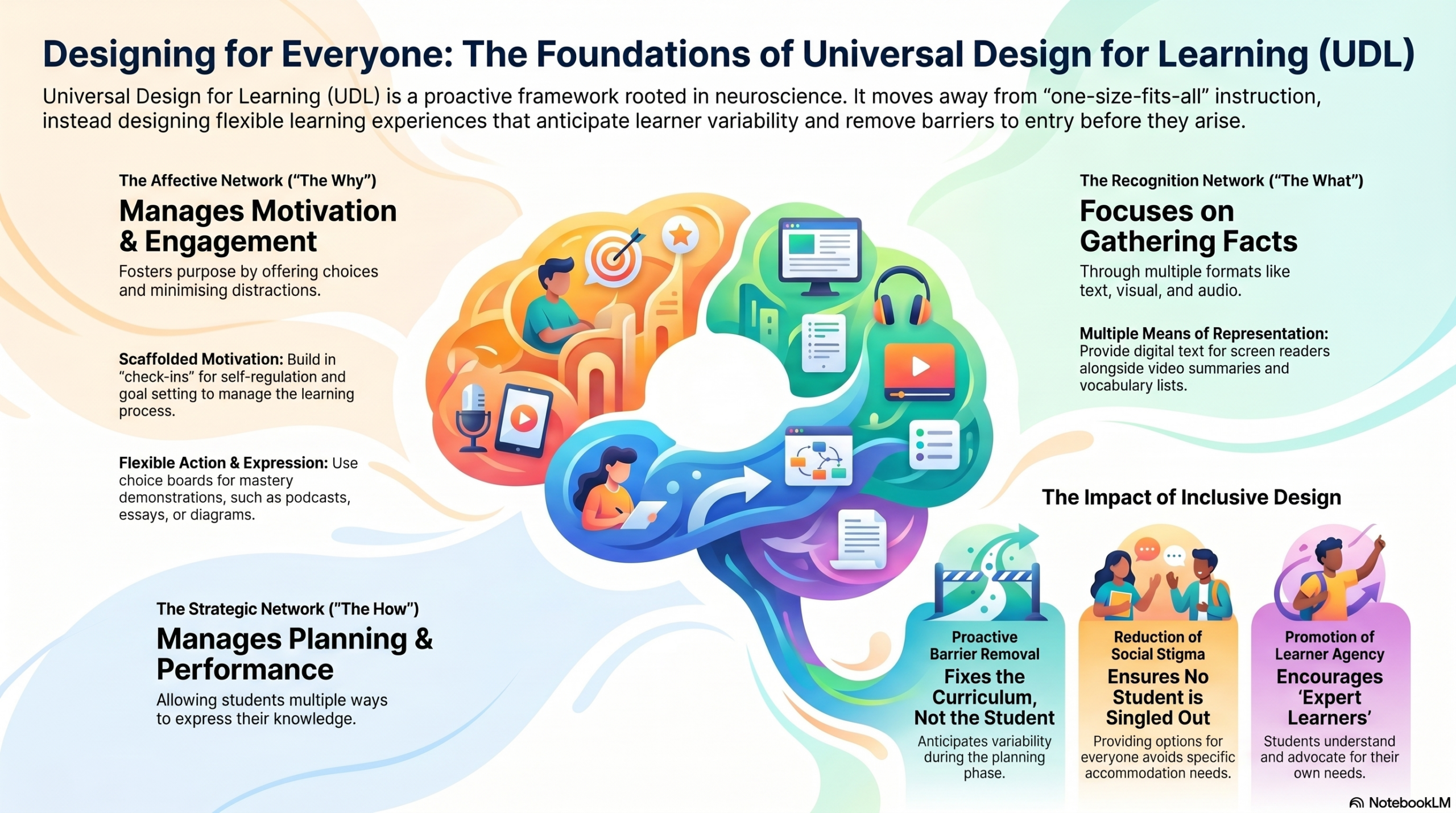
Universal Design for Learning (UDL) is a framework that shifts the focus from “fixing” the student to “fixing” the curriculum. By proactively designing learning experiences that anticipate learner variability, educators can remove barriers to entry before they even arise, rather than applying retrofitted accommodations later.

1. The Three Networks of Learning

UDL is rooted in the neuroscience of how the brain learns. By targeting three distinct brain networks, you ensure that instruction is accessible to all students, regardless of their cognitive or learning profile.

  • The Affective Network (“The Why”): This network manages engagement and motivation. UDL strategies here focus on offering choices, minimizing distractions, and fostering a sense of purpose.
  • The Recognition Network (“The What”): This network is for gathering facts and categorizing what we see, hear, and read. Providing information in multiple formats (e.g., text, visual, audio, hands-on) ensures all students can perceive the content.
  • The Strategic Network (“The How”): This network manages planning and performing tasks. UDL ensures that students have multiple ways to express what they know, such as through digital tools, artistic projects, or oral presentations.

2. Practical Strategies for UDL Implementation

StrategyImplementation Tip
Multiple Means of RepresentationProvide digital versions of text that can be read aloud by software, alongside video summaries and key vocabulary lists.
Flexible Action & ExpressionAllow students to demonstrate mastery through a choice board—e.g., writing an essay, recording a podcast, or creating a visual diagram.
Scaffolded MotivationBuild in “check-ins” for self-regulation and goal setting, helping students manage their own learning process.
Clear Learning ObjectivesFocus on the “what” (the core standard) while allowing flexibility on the “how” (the process of reaching it).

3. Benefits for Diverse Learners

UDL is the foundation of an inclusive classroom because it treats “typical” versus “diverse” learners as a false dichotomy.

  • Reduces Stigma: When everyone has access to options (like audiobooks or digital organizers), no single student is “singled out” for needing an accommodation.
  • Supports Neurodiversity: Students with ADHD, Autism, or dyslexia benefit from the inherent flexibility of UDL, as it allows them to bypass their specific barriers to focus on the core learning objective.
  • Promotes Agency: By providing choice and flexibility, UDL encourages students to become “expert learners” who understand how they learn best and can advocate for their own needs.

4. Moving Toward an Inclusive Design

Adopting UDL requires a mindset shift from “one-size-fits-all” instruction to “designed-for-everyone” curriculum.

  • Proactive Planning: Instead of asking, “How do I accommodate this student?” ask, “How can I design this lesson so that no student is excluded?”.
  • Iterative Refinement: Use student feedback to identify where barriers still exist. If a student is consistently struggling with a format, offer a different way to represent that same information.
  • Resource Curation: Build a “toolkit” of flexible materials—such as digital planners, noise-canceling options, and varied reading levels—that are always available to the entire class.

Reflection

UDL is ultimately about providing every student with the opportunity to achieve the same high standards through different paths. In your courses for kids, what are two different ways you could present the instructions so that both visual and tactile learners can engage with the material from the start?

Leave a Comment