The “Science of Reading” refers to the vast body of research from fields like cognitive psychology, neuroscience, and linguistics that explains how the human brain learns to read. Unlike the “whole language” approaches of the past, this research demonstrates that reading is not a natural process—like speaking—but one that must be explicitly and systematically taught.
1. The Simple View of Reading
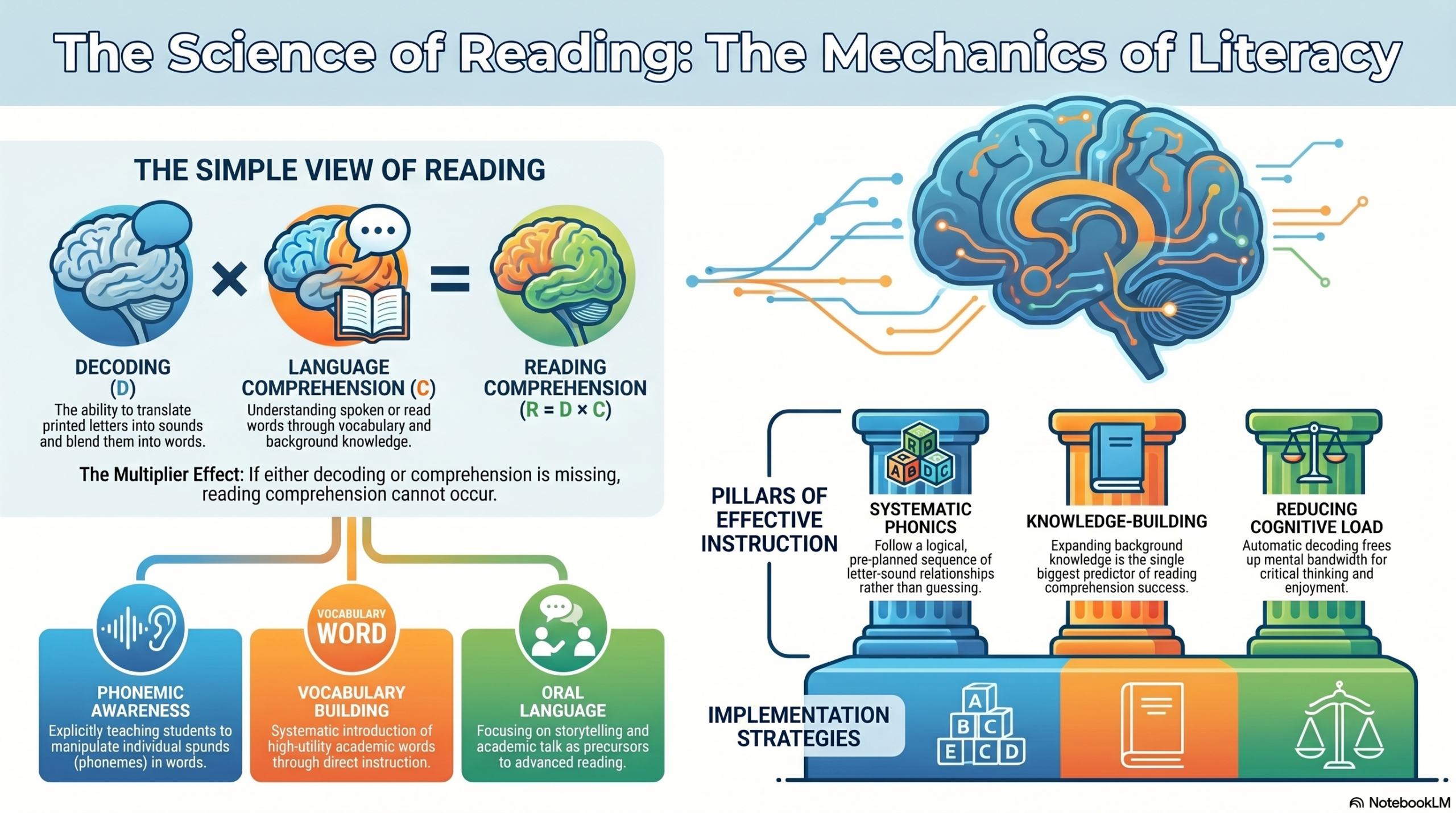
At its core, the Science of Reading is anchored by a foundational formula known as the “Simple View of Reading”: Reading Comprehension = Decoding × Language Comprehension.
- Decoding (Word Recognition): The ability to translate printed letters into sounds and blend them into words. This requires a strong foundation in phonological awareness and phonics.
- Language Comprehension: The ability to understand the words once they are heard or read. This involves vocabulary knowledge, background knowledge, and understanding complex sentence structures.
- The Interdependency: If a student cannot decode, they cannot access the text; if they cannot comprehend language, they cannot understand what they have decoded. Both must be developed simultaneously.
2. Key Components of Instruction
| Strategy | Implementation Tip |
| Phonemic Awareness | Explicitly teach students to manipulate individual sounds (phonemes) in words—the “building blocks” of oral language. |
| Systematic Phonics | Move through a logical, pre-planned sequence of letter-sound relationships rather than relying on guessing based on pictures or context. |
| Vocabulary Building | Systematically introduce high-utility academic words through direct instruction and wide, intentional reading. |
| Knowledge-Building | Use content-rich themes (science, history, etc.) to build the deep background knowledge necessary for students to “make sense” of what they read. |
3. Supporting Diverse Learners
The Science of Reading is inherently inclusive, as it provides a structured, predictable framework that benefits all learners, particularly those who struggle with literacy.
- Preventing “Guessing”: By prioritizing decoding, you remove the reliance on “guessing” strategies that often trip up students with executive functioning challenges or ADHD.
- Structured Repetition: Students with learning disabilities or cognitive delays benefit significantly from the repetitive, systematic approach that phonics instruction provides.
- Reducing Cognitive Load: By making decoding automatic, you free up the student’s “mental bandwidth” to focus on higher-level comprehension, critical thinking, and enjoyment of the text.
4. Moving Beyond the Basics
While the early stages of reading focus on decoding, the long-term goal is automaticity and fluency.
- Deepen Background Knowledge: Literacy is not just about phonics; it is about the world. Design lessons that expand students’ knowledge of diverse topics, as this background knowledge is the single biggest predictor of reading comprehension.
- Oral Language Development: Continue to focus on oral storytelling, discussion, and academic talk, as these are the precursors to advanced reading skills.
- Evidence-Based Assessment: Use diagnostic tools to identify exactly where a student’s breakdown is—is it in the phonics (decoding) or the language (comprehension)? Tailor your intervention accordingly.
Reflection
The Science of Reading is a powerful shift because it moves literacy instruction away from intuition and toward proven neuroscientific pathways. In your courses, could you integrate specific “knowledge-building” modules that help your younger learners build the background knowledge they need to excel in their reading?